
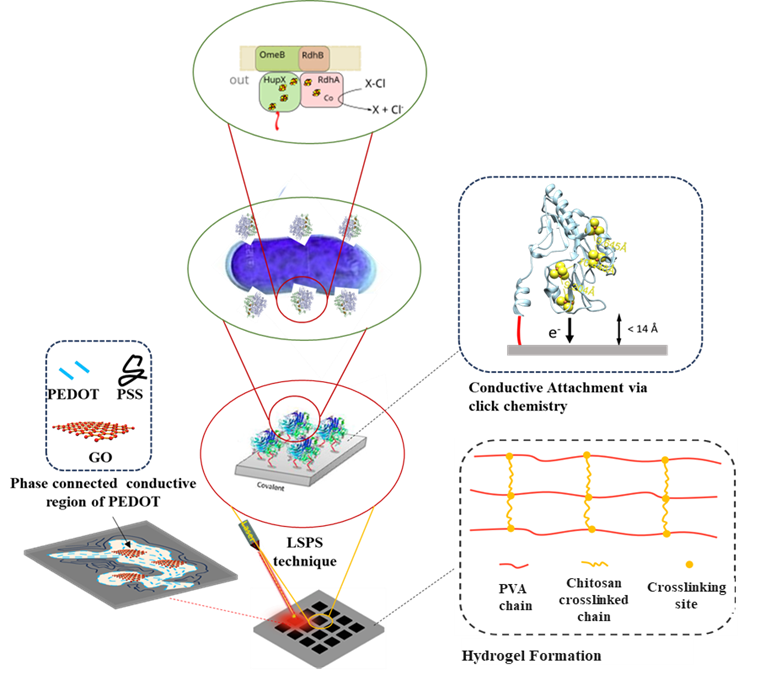
The aim of this project is the development of an Engineered Living Material (ELM) with adaptive functions, composed of living bacterial cells that are electrically connected to conductive hydrogels. This adaptive ELM would find use as a biosensor and as a biocatalyst in the remediation of pollutants.
To achieve this, we employ an innovative laser-scribed phase separation (LSPS) patterning technique that enhances the conductivity of the hydrogel electrode and we coat its surface with a small reactive molecule for the bio-orthogonal clicking of the living organism. Furthermore, we work on the expression of an electron-conductive protein at the surface of bacterial cells and employ genetic code expansion (GCE) technology to introduce a chemical handle for the bio-orthogonal chemistry.
By binding the cells to the hydrogel, we aim at electrically modulating the conductivity of the protein, directly in the live cell.
Team

Principal Investigator
Head, Materials and Biosensor Technologies
Institute for Materials Science
Christian-Albrechts-Universität zu Kiel
PhD Student
Materials and Biosensor Technologies
Institute for Materials Science
Christian-Albrechts-Universität zu Kiel

Principal Investigator
Head, Department of Molecular Environmental Biotechnology (MEB)
Helmholtz Centre for Environmental Research, Leipzig
Technical University Berlin
PostDoc
Department of Molecular Environmental Biotechnology (MEB)
Helmholtz Centre for Environmental Research, Leipzig
Technical University Berlin

Associated PhD Student
Bioprocess Engineering
Institute of Biotechnology
Technical University Berlin
Co – Investigator
Head, Chemical Synthetic Biology and Xenobiology
University of Manitoba