
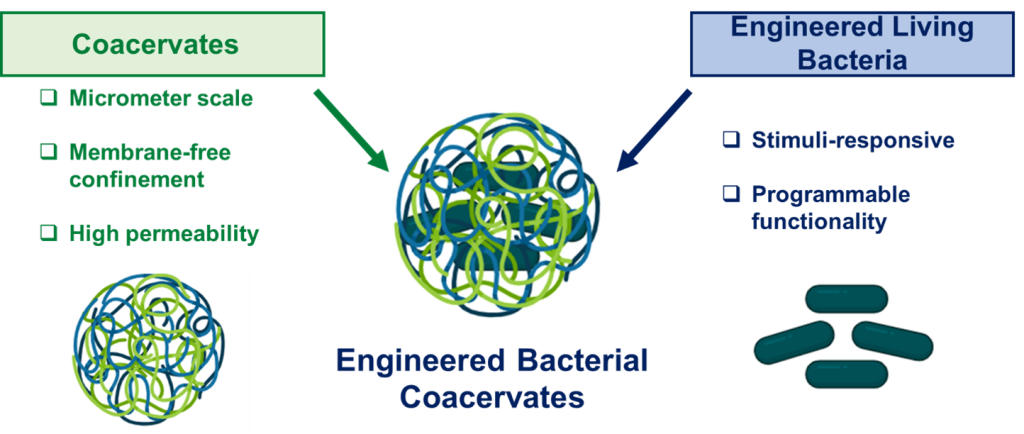
By synergizing the advantages of synthetic compartments and engineered living cells, we can unlock new frontiers in the development of engineered living materials (ELMs). In this work, we introduce engineered bacterial coacervates (EBCs) as a novel hybrid material combining predefined structural properties with biological adaptability. We establish EBCs as innovative platforms for microbial biotechnology, where bacterial functionality is enhanced through interaction with polymer-based coacervates. Specifically, the coacervates act as membrane-less compartments that confine bacteria, enabling the controlled uptake and release of metabolites. Conversely, the encapsulated engineered bacteria endow the coacervates with on-demand properties that can be precisely tuned via genetic engineering.
Our research program is structured around three main objectives. First, we establish a versatile EBC toolbox by encapsulating various biotechnologically relevant bacteria strains, characterizing their viability, metabolic activity, and long-term stability. Second, we probe the environmental responsiveness of EBCs, focusing on the regulation of bacterial activity via external stimuli and the potential for inter-coacervate communication through signaling molecules. Third, we investigate the bidirectional interaction between the biological and synthetic phases, specifically comparing the protective effects of artificial confinement to natural biofilm formation and analyzing the subsequent impact on material stability. Together, these objectives will lead to the creation of auto-regulatory EBCs with adaptive and dynamic responsiveness.
Team

Principal Investigator
Light-controlled Systems
Institute for Physiological Chemistry and Pathobiochemistry
University Münster

Principal Investigator
Head, Institute of Molecular Microbiology and Biotechnology
University Münster

PhD Student
University Münster
Institute of Molecular Microbiology and Biotechnology